BHN’s Dr. Abi-Ghanem Selected to Speak at Soil Society Leadership Panel

Dr. Rita Abi-Ghanem, Senior Director of Research & Development at Bio Huma Netics, Inc., has been selected to speak as part of a Soil Science Society of America (SSSA) panel discussion on Leadership at the 2019 International Soils Meeting, “Soils Across Latitudes, on January 8, 2019, in San Diego, California. Dr. Abi-Ghanem will be representing an Industry perspective. Other panelists include Dr. Johannes Bouma, Emeritus Professor of Soil Science, Wageningen University, Netherlands (International); Dr. Alfred Hartemink, Professor of Soil Science and Dept. Chair, University of Wisconsin, Madison (Academia); Dr. Ole Wendroth, SSSA Incoming President-Elect, Professor at University of Kentucky (SSSA); and Dr. David Lindbo, Director of Soil Science Division, United States Department of Agriculture (Government).

The panel discussion will be held at 10:30 a.m. until 12 noon on Tuesday at the Sheraton Hotel, Spinnaker 1. The discussion will be focused on professional leadership skills needed by students, post-docs, and early career members.

Dr. Abi-Ghanem—a native of Lebanon and a Fulbright Scholar who earned her doctorate in Soil Science from Washington State University—was honored earlier this year when she was selected for two 40-Under-40 awards sponsored by The Phoenix Business Journal and jointly by the editors of Fruit Growers News and Vegetable Growers News. She was previously presented with the Association for International Agriculture 2016 Young Professional Award. She has been Senior Director of Research & Development for Bio Huma Netics, Inc., since 2014.
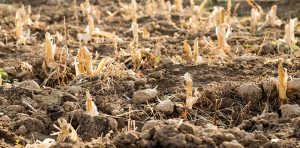
It All Has to Start With The Soil

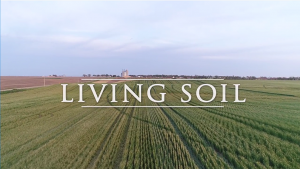
The Soil Health Institute has released a 60-minute documentary, Living Soil, that captures the history — and significance — of the soil health movement.

Our soils support 95 percent of all food production, and by 2060, our soils will be asked to give us as much food as we have consumed in the last 500 years. They filter our water. They are one of our most cost-effective reservoirs for sequestering carbon. They are our foundation for biodiversity. And they are vibrantly alive, teeming with 10,000 pounds of biological life in every acre. Yet in the last 150 years, we’ve lost half of the basic building block that makes soil productive. The societal and environmental costs of soil loss and degradation in the United States alone are now estimated to be as high as $85 billion every single year.
Living Soil captures the background of the current soil health movement and its momentum, beginning with painful images of the Dust Bowl, and then transitions to personal experiences of innovative women and men who are managing their land to enhance soil health.

The film features rural and urban farmers from Maryland to California, selling everything from corn to bouquets, united by their care for the soil.

The documentary is directed by Chelsea Myers, founder of Tiny Attic, a video production company located in Columbia, Mo. that specializes in documenting real moments and real people.

To view the documentary, visit https://livingsoilfilm.com.

World Soil Day, November 5

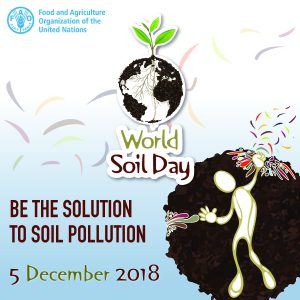
The Food and Agriculture Organization of the United Nations sponsors World Soil Day every December 5 to focus attention on the importance of healthy soil and the sustainable management of soil resources. Sponsored every year since 2014, this year’s theme focuses on soil pollution. Here is an excerpt from the World Soil Day Website:

“These days pollution is a worry – and soil is also affected. Soil pollution is a hidden danger that lurks beneath our feet.

“1/3 of our global soils are already degraded. Yet we risk losing more due to this hidden danger. Soil pollution can be invisible and seems far away but everyone, everywhere is affected. With a growing population expected to reach 9 billion by 2050, soil pollution is a worldwide problem which degrades our soils and poisons the food we eat, the water we drink, and the air we breathe. The entity of the problem is still unknown as not certain data are available on a global scale.

“Soils have a great potential to filter and buffer contaminants, degrading and attenuating the negative effects of pollutants, but this capacity is finite. Most of the pollutants originate from human activities, such as unsustainable farming practices, industrial activities and mining, untreated urban waste, and other non-environmental friendly practices. As technology evolves, scientists are able to identify previously undetected pollutants, but at the same time these technological improvements lead to new contaminants being released into the environment. In the Agenda for Sustainable Development 2030, the Sustainable Development Goals 2, 3, 12, and 15 have targets that commend direct consideration of soil resources, especially soil pollution and degradation in relation to food security.

“It is time to uncover this threatening reality. Combatting soil pollution requires us to join forces and turn determination into action. Be the solution to soil pollution.”

At Bio Huma Netics, Inc., we take soil health seriously. Visit our product Websites to find solutions for improving agricultural soil (Huma Gro® and Fertilgold® Organics) and bioremediation of contaminated soils (Probiotic Solutions®).


BHN 2018 World Conference

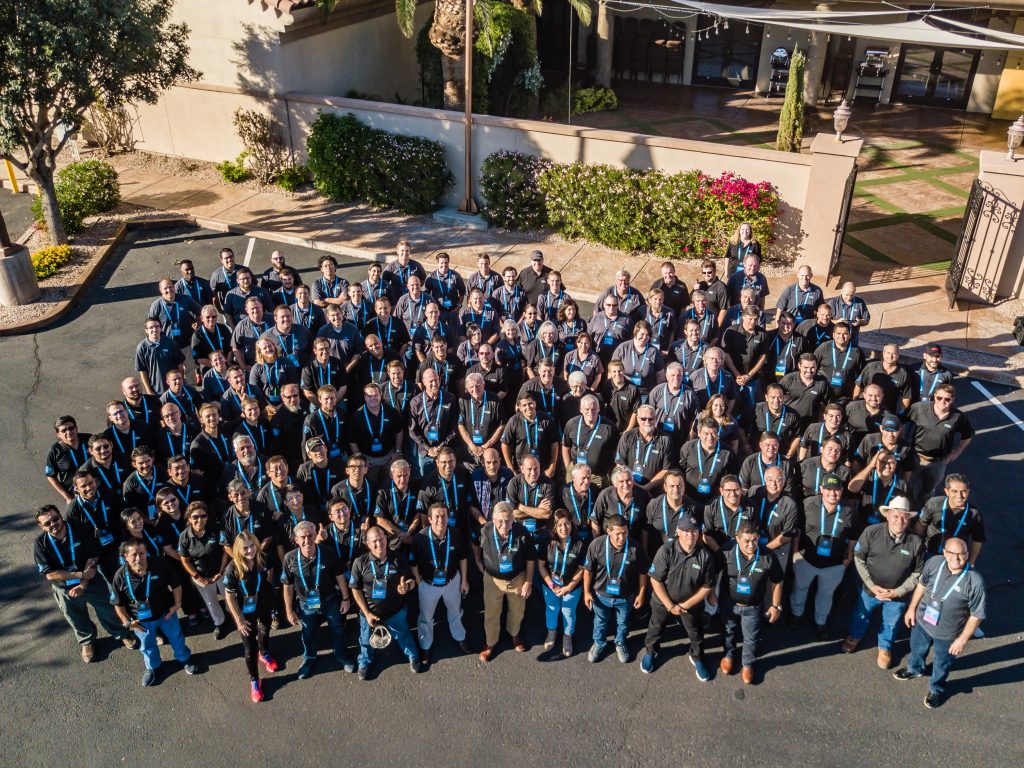
The biannual Bio Huma Netics, Inc. (BHN), World Conference was held November 6­–9, 2018, at the DoubleTree by Hilton Conference Center in Gilbert, Arizona. The BHN World Conference was attended by 72 Huma Gro®, Huma Gro® Turf, and Probiotic Solutions® product distributors and users representing 18 countries.

Conference attendees were welcomed by BHN President and CEO Lyndon Smith in an opening address with a theme of “Integrity Is Power.” The conference included two days of product information and education presentations, including the official launch of the company’s new Fertilgold® Organics product line for organic agriculture. An awards banquet was held on Thursday evening, and on Friday attendees had an opportunity to tour a local farm and to go horseback riding.

Conference attendees will be receiving an email link to view and download event photos at Flickr. Presentation PDFs have been posted to the BHN Hub; presentation videos will also be posted on the BHN Hub in coming weeks.

BHN alternates its biannual World Conferences in Arizona with regional conferences held on odd-numbered years. The next regional conference will be held in Turkey in 2019.

Select the image below to play the conference theme video.

Lanzamiento de la aplicación de Huma Gro® para teléfonos inteligentes con iOS

Se ha lanzado la aplicación de Huma Gro® para teléfonos inteligentes con iOS y está disponible de forma gratuita en Apple App Store. La aplicación de Huma Gro® contiene una calculadora para la aplicación foliar que determina qué cantidad de producto se debe aplicar a cultivos específicos en campos de cualquier tamaño según los análisis de laboratorio, una biblioteca con documentos de los productos que se actualiza constantemente, una guía de mezcla de productos, la capacidad de guardar la información de las aplicaciones del producto y cálculos por campo, y actualizaciones de características y novedades permanentes en el blog del sitio web de Huma Gro®.
Justin Smith, Vicepresidente Ejecutivo de Ventas de Huma Gro® afirmó: “La aplicación de Huma Gro® le permite a los agricultores y los distribuidores tener siempre la información más actualizada de cada producto Huma Gro® (lo que incluye la etiqueta, la HDS y el boletín técnico del producto) y es muy útil en el campo para poder calcular qué cantidad de producto se necesita para obtener el mejor rendimiento. Asimismo, la aplicación permite a los agricultores y los distribuidores comunicarse directamente con el equipo de ventas de Huma Gro® ante cualquier duda que tengan respecto de los productos Huma Gro® y su utilización”.

La línea de protección y nutrición líquida de cultivos Huma Gro® incluye 11 productos con macronutrientes primarios, 16 productos con micronutrientes y macronutrientes secundarios, 5 productos fertilizantes sustentables para suelos, 9 productos de regulación óptima del crecimiento, 5 productos líquidos de ácidos orgánicos con alto contenido de carbono, y 2 productos para la protección de cultivos con cero residuos. Toda la línea cuenta con el sistema de suministro patentado y ultraeficiente Tecnología Micro Carbono® que permite a los agricultores y reguladores de cultivos lograr mejores resultados con menor cantidad de producto. También se encuentran disponibles 9 productos granulados con ácidos orgánicos ricos en carbono (en la categoría Huma Burst®).  Para obtener más información sobre los productos Huma Gro®, visite https://www.humagro.com/.

También se ha mejorado la versión Android de la aplicación de Huma Gro® lanzada anteriormente y se encuentra disponible en Google Play Store.

Para saber más sobre los productos Huma Gro haga clic aqui.

Hats Off to Farmers, Today and Every Day

Agriculture is one of the world’s oldest industries. In fact, many countries’ economies still depend on the agricultural industry. Today, on October 12, we recognize the hard work that goes into feeding a nation. Previously known as Old Farmers Day, National Farmers’ Day dates back to the 1800s, a time when a higher percentage of the population was involved in agriculture, with harvest festivals and events in September and October. National Farmers Day encourages Americans to thank farmers and ranchers for providing the food, clothing, fuel, and materials that we otherwise take for granted.

See how The Old Farmer’s Almanac celebrates National Farmer’s Day: https://www.almanac.com/newsletters/archive/2018-10-12

Huma Gro® App Released for iOS Smart Phones

The Huma Gro® app for iOS smart phones has been released and is available for free at the Apple App Store. The Huma Gro® App provides a foliar application calculator for determining how much product to apply to specific crops on any size of field based on lab analysis, a continuously updated product document library, a product mixing guide, the ability to save product application data and calculations by field, and continuous news and feature updates from the Huma Gro® Website blog.

Justin Smith, Executive Vice President of Huma Gro® Sales, said, “The Huma Gro® app allows growers and distributors to always have the most up-to-date information on every Huma Gro® product (including the label, SDS, and product technical bulletin), and it is very useful in the field to be able to calculate how much product is needed to get the best yields. In addition, the app provides a way for growers and distributors to directly contact the Huma Gro® Sales Team with any questions they may have regarding Huma Gro® products and their use.”

The Huma Gro® liquid crop nutrition and protection line includes 11 Primary Macronutrient products, 16 Secondary Macronutrient and Micronutrient products, 5 Sustainable Soil Fertility products, 9 Optimal Growth Management products, 5 liquid Carbon-Rich Organic Acid products, and 2 Zero-Residue Crop Protection products—all with the ultra-efficient, proprietary Micro Carbon Technology® delivery system that allows growers and crop managers to achieve far more with much less product. Also available are 9 granular Carbon-Rich Organic Acid Products (in the Huma Burst® category). Additional information on Huma Gro® products is available at https://www.humagro.com/.

The previously released Android version of the Huma Gro® app has also been enhanced and is available at the Google Play Store.

Liquid Sili-Max® Improves Wheat Yield at Much Higher Efficiency Than Conventional Dry Silicon Fertilizers

Research by Brenda Tubana, PhD, Louisiana State University

The objective of this study was to compare, for use in Louisiana wheat production, the efficacy of a liquid silicon (Si) fertilizer (Huma Gro® Sili-Max®) with a commonly used dry Si source (steel slag) and another Si source (wollastonite) often used in research as a suspension. Silica deposition is an important barrier for foliar fungal diseases.

The wheat field study was conducted at Louisiana Ag-Center Research Stations. Silicon (Si) treatments were replicated four times and arranged in a randomized block design. There were 2 Huma Gro® Sili-Max® (10% Si) treatments (as a foliar band, and as foliar broadcast sprayed evenly over the entire plot). Each treatment was applied twice within 2 weeks at the onset of internode elongation (Feekes growth stage 5). The dry silicon sources (wollastonite [23% Si] and steel slag [11% Si]) were applied and incorporated into the soil prior to planting. Wheat leaf samples were collected one week after the application of silicon solution sources and evaluated for silica bodies (phytolith) deposition and percentage using scanning electron microscopy and energy dispersive x-ray analysis.

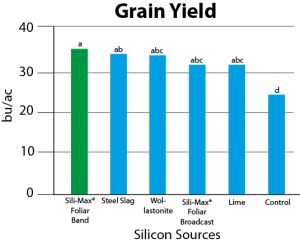
Sili-Max® foliar band and Sili-Max® foliar broadcast increased grain yield by 10 and 7 bu/ac, respectively, in reference to the control plot (Fig. 1). It is important to note that the total silicon applied using Sili-Max® solution was substantially lower (0.064 to 0.128 lb Si/ac) than the dry wollastonite and steel slag silicon sources (250 lb Si/ac). The state average wheat yield was low that year due to a mild winter that affected the wheat vernalization. Sili-Max® foliar band had the numerically highest straw yield at 7,941 lb/ac.

The accumulated silica bodies (phytolith) were 0.69% and 0.60% with Sili-Max® foliar broadcast and Sili-Max® foliar band treatments, respectively while the control had 0.53%.

Conclusions
Huma Gro® Sili-Max® applied as foliar band at a rate 3,900 times less than the dry silicon sources contributed to higher grain yield and straw yield, while the application of Sili-Max® as a foliar broadcast at a rate 1,900 times less than the dry silicon sources led to high Si deposition in wheat leaves.

View Online           Download PDF

El otoño es el momento de Fertil Humus®

En un blog del Departamento de Agricultura de los Estados Unidos (USDA) reciente, Spencer Miller expone los argumentos del caso “noviembre sin labranza”: la labranza repetida deteriora la estructura del suelo y reduce la estabilidad de los agregados. Descompone la materia orgánica y drena el carbón del suelo. Miller cita a Neil Sass, un agrónomo del USDA, que describió el drástico efecto que tiene la labranza en la microbiología del suelo “similar al de un terremoto, un tornado y un incendio que ocurren todos al mismo tiempo”. Y, al no causar ese tipo de devastación en el microbioma, “cuando se tiene el sostén de billones de microbios, se puede producir más con menos”.

Asimismo, de acuerdo con Sass, no labrar permite que el suelo absorba mucha más agua y resista lluvias fuertes, lo cual mantiene el suelo en el campo y fuera de la cuenca. Y agrega, “no labrar le hará ahorrar tiempo y dinero. Pasará menos tiempo en su tractor. Utilizará menos combustible. Desgastará menos su equipo. No labrar es una solución que implica un beneficio tanto para el suelo como para su billetera”.

Lo cual no quiere decir que no haya nada que pueda hacer en el otoño para ayudar a preparar el suelo para plantar en primavera y fortalecer el microbioma. Aplicar nuestro producto Fertil Humus® de Huma Gro® en otoño puede ayudar a degradar los residuos de los cultivos o los deshechos que quedan del campo de cultivo y a convertirlos en humus durante el invierno. También estimula la actividad microbiana, especialmente de los hongos micorrícicos que tienen una relación simbiótica con las raíces de las plantas. Estos hongos cumplen una función clave en la liberación de los nutrientes que están inmovilizados en la materia orgánica del suelo.

Fertil Humus® buferizará las toxicidades de los pesticidas sobrantes al romper sus cadenas hidrocarbonadas dejándolas sin efecto. Además, reducirá la toxicidad del fósforo (por ejemplo, por aplicación excesiva de estiércol de gallina) que puede provocar la deficiencia/inmovilización del zinc-manganeso.

Para la aplicación en el campo después de la cosecha de otoño, recomendamos Fertil Humus® de 1 a 2 cuartos de galón por acre (2,5 a 5 litros/hectárea) mediante pulverización o riego por inundación o por surcos. Esto preparará el suelo para la plantación de primavera con mejor estructura, actividad microbiana y disponibilidad de nutrientes.

Para obtener más información sobre Fertil Humus® de Huma Gro® haga clic aquí, o comuníquese con un representante de Huma Gro® haciendo clic en el botón que se encuentra debajo. Para obtener más información sobre los productos para suelos de Huma Gro®, haga clic aquí.

Para saber más sobre los productos Huma Gro haga clic aqui.

Fall Is Fertil Humus® Time

In a recent USDA blog, Spencer Miller states the case for “No-Till November”: Repeated tillage undermines the soil structure and reduces aggregate stability. It breaks down organic matter and drains carbon from the soil.” He quotes Neil Sass, a USDA agronomist, who described the dramatic effect tillage has on soil microbiology as “akin to an earthquake, tornado, and fire happening all at the same time.” And by not inflicting that kind of devastation on the microbiome, “when you have the support of trillions of microbes, you can grow more with less.”

Also, according to Sass, no-till allows the soil to absorb much more water and handle heavy rain, which keeps soil on the field and out of the watershed. He continues, “No-till will save you time and money. You’ll spend less time on your tractor. You’ll use less fuel. You’ll have less wear and tear on your equipment. No-till is a win-win for your soil and for your pocketbook.”

Which is not to say that there is nothing you can do in the fall to help prepare your soil for spring planting and fortify the microbiome. Our Huma Gro® Fertil Humus® product, when applied in the fall, can help degrade any crop residue or crop field trash that’s left behind and convert it to humus over the winter. It also stimulates microbial activity, especially mycorrhizal fungi that have a symbiotic relationship with plant roots. These fungi play a key role in freeing nutrients that are tied up in soil organic matter.

Fertil Humus® will buffer the toxicities of left-over pesticides, breaking their hydrocarbon chains to render them ineffective. It will also decrease phosphorus toxicity (e.g., from over-applied chicken manure) that can lead to zinc-manganese tie-up/deficiency.

For fall after-harvest field application, we recommend Fertil Humus® at 1–2 quarts/acre (2.5–5.0 liters/hectare) as a broadcast spray or flood or furrow irrigated. This will set up your soil for spring planting with better tilth, microbial activity, and nutrient availability.

For more information on Huma Gro® Fertil Humus® click here, or contact a Huma Gro® representative by clicking the button below. For more about our Huma Gro® soil products, click here.


Translate »
>